2023/9/21
Share to:
Nitrile Glove Thickness Guide: 3 Mil vs 5 Mil vs 7 Mil
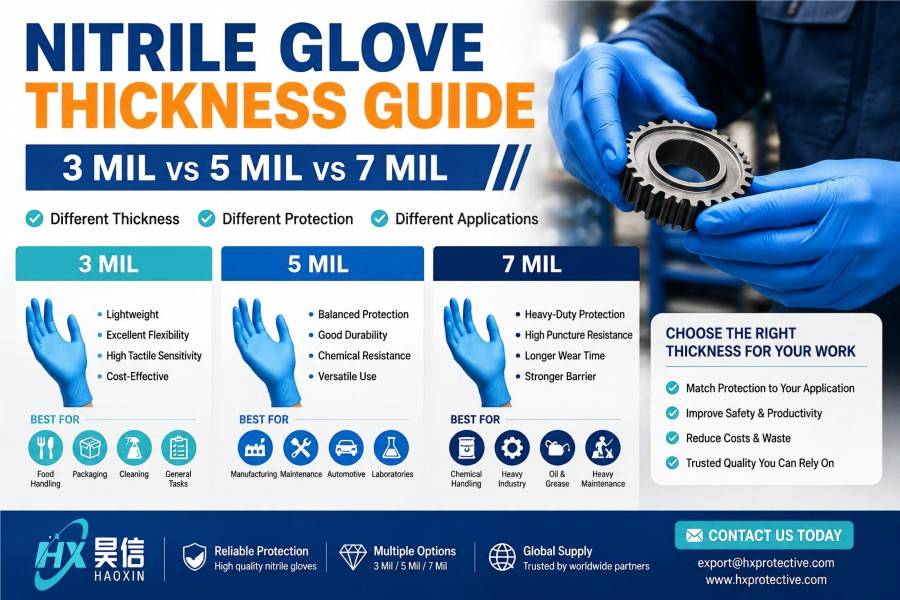
Choosing the right nitrile glove thickness is an important decision for industrial buyers, distributors, and professional users. While many buyers focus on glove material and price, thickness directly affects protection, durability, comfort, and performance.
A thinner nitrile glove may provide better flexibility and hand sensitivity, while a thicker glove usually offers improved durability and resistance for demanding applications.
This nitrile glove thickness guide explains the differences between 3 mil, 5 mil, and 7 mil nitrile gloves and helps buyers select the right option for different industrial applications.
Quick Overview:
3 mil nitrile gloves are lightweight and suitable for short-term tasks. 5 mil nitrile gloves provide a balance between protection and flexibility. 7 mil nitrile gloves are designed for heavier-duty applications requiring higher durability.
1. Why Nitrile Glove Thickness Matters
Nitrile glove thickness determines how a glove performs in different working environments.
For industrial buyers, thickness affects several important factors:
Protection against punctures and tears
Resistance to chemicals and oils
Glove lifespan during use
Hand flexibility and sensitivity
Worker comfort during long shifts
Selecting the wrong thickness can create problems. A glove that is too thin may fail during demanding tasks, while an overly thick glove may reduce dexterity and increase costs.
Thickness should always match the actual working environment.
2. Understanding Nitrile Glove Thickness Measurements
Nitrile glove thickness is usually measured in mil.
One mil equals one thousandth of an inch (0.001 inch).
For example:
3 mil = approximately 0.003 inch thickness
5 mil = approximately 0.005 inch thickness
7 mil = approximately 0.007 inch thickness
However, glove thickness may vary between manufacturers and different areas of the glove. Palm thickness and fingertip thickness are often different because fingertips usually require additional protection.
3. 3 Mil Nitrile Gloves: Lightweight and Flexible
3 mil nitrile gloves are designed for applications where flexibility, comfort, and cost efficiency are important.
They are commonly used for tasks that require frequent glove changes rather than heavy protection.
Advantages of 3 Mil Nitrile Gloves
Excellent hand flexibility
Better tactile sensitivity
Lower material cost
Comfortable for extended wear
Suitable for high-volume usage
Common Applications
Food handling
Light assembly work
Cleaning services
General inspection
Packaging operations
For industries where workers frequently replace gloves and require maximum flexibility, 3 mil nitrile gloves can provide an economical solution.
4. 5 Mil Nitrile Gloves: The Most Popular Industrial Choice
5 mil nitrile gloves are considered one of the most versatile options for professional applications.
They provide a balanced combination of protection, durability, and comfort, making them widely used across multiple industries.
Advantages of 5 Mil Nitrile Gloves
Better puncture resistance than thinner gloves
Good chemical protection
Suitable for longer working periods
Maintains good hand flexibility
Excellent balance between performance and cost
Common Applications
Automotive maintenance
Manufacturing
Industrial cleaning
Machine operation
Laboratory applications
For most industrial buyers, 5 mil nitrile gloves are often the preferred specification because they meet a wide range of workplace requirements.
5. 7 Mil Nitrile Gloves: Heavy-Duty Protection
7 mil nitrile gloves are designed for demanding industrial environments where higher durability and stronger protection are required.
Compared with thinner nitrile gloves, 7 mil gloves provide better resistance against punctures, tears, and extended wear.
Advantages of 7 Mil Nitrile Gloves
Higher puncture and tear resistance
Better durability for heavy-duty tasks
Improved protection against industrial chemicals
Suitable for longer continuous use
Reduced glove replacement frequency
Common Applications
Automotive repair
Chemical handling
Heavy maintenance work
Industrial manufacturing
Oil and grease applications
Although thicker gloves provide better protection, they may slightly reduce hand sensitivity compared with thinner options. Therefore, buyers should select thickness based on actual workplace requirements.
6. 3 Mil vs 5 Mil vs 7 Mil Nitrile Gloves Comparison
The following comparison helps buyers quickly understand the differences between common nitrile glove thickness options.
| Thickness | Protection Level | Flexibility | Recommended Applications |
|---|---|---|---|
| 3 Mil | Light Protection | Excellent | Food handling, packaging, general tasks |
| 5 Mil | Medium Protection | Very Good | Manufacturing, automotive, maintenance |
| 7 Mil | Heavy Protection | Good | Chemical handling, heavy industry, repair work |
7. How to Choose the Right Nitrile Glove Thickness for Different Industries
The best glove thickness depends on the specific application, working environment, and protection requirements.
Food Processing
Food processing usually requires frequent glove changes and good hand flexibility.
Recommended: 3 Mil or 5 Mil Powder-Free Nitrile Gloves
Automotive Industry
Automotive workers often deal with oils, grease, lubricants, and mechanical parts.
Recommended:5 Mil or 7 Mil Nitrile Gloves
Manufacturing Industry
Manufacturing applications require a balance between protection and dexterity.
Recommended:5 Mil Nitrile Gloves
Chemical Handling
Applications involving chemicals require thicker gloves with better barrier performance.
Recommended:7 Mil or Heavy-Duty Nitrile Gloves
Cleaning Services
Cleaning companies usually need gloves that provide protection while keeping operating costs reasonable.
Recommended:5 Mil Nitrile Gloves
8. Does a Thicker Nitrile Glove Always Mean Better Protection?
Many buyers assume that thicker gloves always provide better protection. However, thickness is only one factor affecting glove performance.
Other important factors include:
Nitrile material quality
Manufacturing consistency
Chemical resistance testing
Glove design and fit
Application requirements
For example, a high-quality 5 mil nitrile glove may perform better than a low-quality thicker glove in certain applications.
Professional buyers should evaluate overall glove performance rather than thickness alone.
9. Buying Tips for Importers and Distributors
For international buyers, choosing the right nitrile glove specification is only part of the purchasing process. Selecting a reliable manufacturer is equally important.
Check Product Specifications
Thickness options
Material quality
Sizes available
Color options
Packaging requirements
Confirm Quality Standards
Professional buyers should check whether suppliers can provide relevant testing documents and quality control information.
Consider OEM Capability
For distributors building their own PPE brands, OEM packaging and customization support can create stronger market advantages.
A reliable manufacturer should support:
Private label packaging
Custom carton design
Bulk production
Stable supply capacity
Frequently Asked Questions
Q1: Are 7 mil nitrile gloves better than 5 mil gloves?
7 mil nitrile gloves provide higher durability and protection, but 5 mil gloves offer better flexibility and are suitable for more general industrial applications.
Q2: Which nitrile glove thickness is best for automotive work?
Most automotive applications use 5 mil or 7 mil nitrile gloves because they provide better resistance against oils, grease, and mechanical wear.
Q3: Are thicker gloves less comfortable?
Thicker gloves may slightly reduce flexibility, but the difference depends on glove design, material quality, and fit.
Q4: What thickness do most industries choose?
5 mil nitrile gloves are one of the most popular choices because they provide a good balance between protection, comfort, and cost.
Need the Right Nitrile Glove Solution?
HXProtective supplies disposable nitrile gloves for industrial users, distributors, and global PPE buyers.
We support different glove thickness options, OEM packaging, and customized solutions for various industries.
Conclusion
Selecting the right nitrile glove thickness depends on the balance between protection, comfort, application requirements, and cost.
3 mil gloves are suitable for lightweight tasks, 5 mil gloves provide a versatile solution for most industrial applications, and 7 mil gloves are designed for more demanding environments.
For distributors and industrial buyers, working with an experienced nitrile glove manufacturer ensures stable quality, reliable supply, and customized solutions.
Related Articles
News Center
Industry News



 WhatsApp
Send us your message
You can send an email asking for the price and detailed information of this product. We will reply you as soon as we receive your email