2023/9/21
Share to:
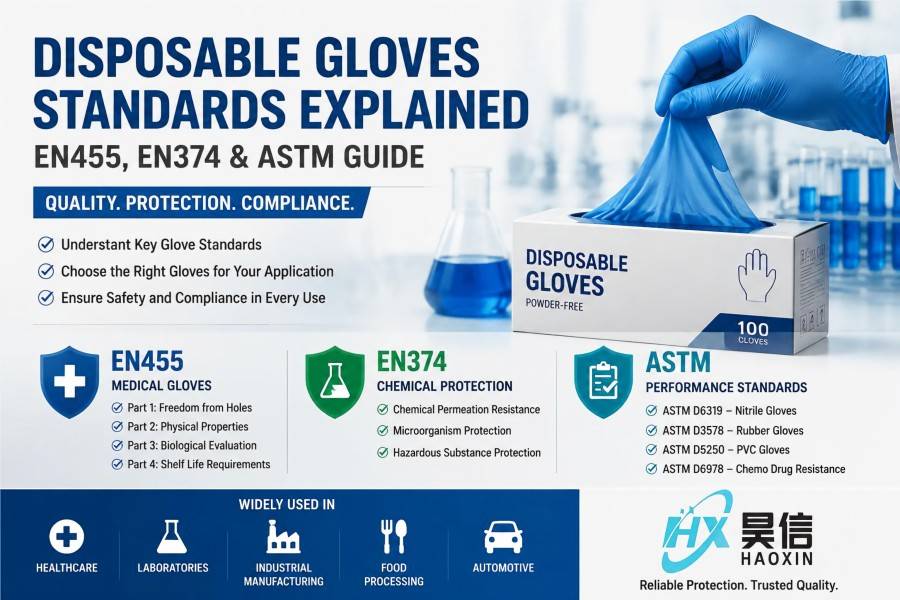
Disposable Gloves Standards Explained: EN455, EN374 & ASTM Guide
Quick Summary
Disposable glove standards help buyers evaluate product quality, protection level, and suitability for different applications. EN455 focuses on medical glove requirements, EN374 covers chemical protection, and ASTM standards define performance requirements for disposable gloves in various industries.
1. Why Disposable Glove Standards Matter
When purchasing disposable gloves, many buyers focus on material, thickness, and price. However, compliance with recognized standards is equally important.
Standards provide a consistent way to evaluate glove performance, including durability, protection, leakage resistance, and suitability for specific applications.
For international distributors and industrial buyers, understanding glove certifications helps select reliable products and reduce quality risks.
2. Overview of Major Disposable Glove Standards
Different markets and industries use different standards to evaluate disposable glove performance.
| Standard | Main Purpose | Common Applications |
|---|---|---|
| EN455 | Medical glove requirements | Healthcare and medical applications |
| EN374 | Chemical and microorganism protection | Industrial and laboratory use |
| ASTM Standards | Performance testing requirements | Healthcare, food, industrial applications |
3. EN455 Standard for Medical Disposable Gloves
EN455 is a European standard mainly used for medical examination gloves. It defines requirements related to safety, quality, and performance.
The standard consists of several parts covering different glove characteristics.
EN455-1: Freedom from Holes
This part evaluates the leak resistance of medical gloves. Gloves must meet specific requirements to reduce the risk of liquid penetration.
EN455-2: Physical Properties
This section covers physical performance, including dimensions, strength, and durability.
EN455-3: Biological Evaluation
This requirement focuses on glove materials and evaluates factors such as biological safety and chemical residues.
EN455-4: Shelf Life Requirements
This part evaluates how glove performance is maintained during storage over time.
4. EN374 Standard for Chemical Resistant Gloves
EN374 is related to protective gloves designed for chemical risks and hazardous substances.
It helps users understand whether gloves are suitable for specific chemical exposure situations.
Key Areas Covered by EN374:
Chemical permeation resistance
Protection against microorganisms
Performance against hazardous substances
Common Applications:
Chemical handling
Laboratory work
Industrial cleaning
Manufacturing processes
Automotive maintenance
5. ASTM Standards for Disposable Gloves
ASTM International develops widely recognized testing standards used in North America and many global markets.
ASTM standards evaluate glove performance based on different application requirements.
Common ASTM Standards Include:
ASTM D6319 – Specification for nitrile examination gloves
ASTM D3578 – Specification for rubber examination gloves
ASTM D5250 – Specification for PVC medical examination gloves
ASTM D6978 – Resistance of medical gloves to chemotherapy drugs
6. EN455 vs EN374 vs ASTM: Key Differences
| Standard | Main Focus | Suitable For |
|---|---|---|
| EN455 | Medical glove quality and safety | Healthcare applications |
| EN374 | Chemical protection performance | Industrial and laboratory applications |
| ASTM | Performance testing specifications | North American and global markets |
7. Which Standards Do Different Industries Need?
Healthcare Industry
Medical facilities usually require gloves meeting medical glove standards such as EN455 or equivalent requirements.
Food Processing Industry
Food businesses typically focus on gloves that provide safe handling, cleanliness, and compliance with food contact requirements.
Industrial Manufacturing
Manufacturing companies often prioritize durability, chemical resistance, and protection against workplace hazards.
Laboratory Applications
Laboratories usually require gloves with reliable chemical resistance and contamination control performance.
8. What Buyers Should Check Before Ordering Disposable Gloves
Certificates and standards are important, but buyers should also evaluate supplier capability and product consistency.
Material type: nitrile, latex, or vinyl
Glove thickness and strength
Testing reports and certifications
Production quality control
Packaging requirements
OEM customization capability
A professional glove manufacturer should provide clear documentation and stable product quality for long-term cooperation.
9. Why Certification Matters for Global Glove Buyers
For importers and distributors, certified disposable gloves help reduce risks related to product complaints, customer requirements, and market regulations.
Choosing a supplier with experience in international standards makes the purchasing process easier and more reliable.
10. Conclusion
Understanding disposable glove standards helps buyers make better purchasing decisions. EN455 focuses on medical glove requirements, EN374 covers chemical protection, and ASTM standards define performance expectations for different applications.
Before placing bulk orders, companies should evaluate both product compliance and supplier reliability.
HXProtective supplies disposable gloves and industrial PPE solutions for global distributors, wholesalers, and professional users with different protection requirements.
Related Articles
News Center
Industry News




 WhatsApp
Send us your message
You can send an email asking for the price and detailed information of this product. We will reply you as soon as we receive your email